

The Department of Transportation (DOT) physical is a mandatory health exam for anyone operating commercial motor vehicles (CMVs). All commercial motor vehicle (CMV) drivers whose vehicles are a combined gross vehicle weight of 10,001 pounds or more are required to have a Department of Transportation (DOT) Medical Examination. These exams play an essential role in protecting public safety, ensuring that professional drivers are medically fit to handle the physical and mental demands of long hours on the road. A DOT physical evaluates key health markers that could impact a driver’s ability to safely operate a large vehicle, helping reduce accidents, uphold industry standards, and maintain compliance with federal regulations. For both employers and drivers, this routine requirement ensures a safer transportation system for everyone.
ABOUT THE EXAM from FMCA.dot.gov: “A Department of Transportation (DOT) physical examination must be conducted by a licensed “medical examiner” listed on the Federal Motor Carrier Safety Administration (FMCSA) National Registry. The term includes, but is not limited to, doctors of medicine (MD), doctors of osteopathy (DO), physician assistants (PA), advanced practice nurses (APN), and doctors of chiropractic (DC). A DOT physical exam is valid for up to 24 months. The medical examiner may also issue a medical examiner’s certificate for less than 24 months when it is desirable to monitor a condition, such as high blood pressure. If the medical examiner finds that the person he/she examined is physically qualified to drive a commercial motor vehicle (CMV), the medical examiner will furnish one copy of the results to the person who was examined and complete a Medical Examiner’s Certificate.” – Federal Motor Carrier Safety Administration (FMCSA)

How Often Are DOT Physicals Needed?
Most commercial drivers must complete a DOT physical every 24 months. However, certain medical conditions may require more frequent monitoring. If a driver has conditions such as high blood pressure, diabetes, sleep apnea, or other health concerns, the certified medical examiner may issue a shorter-term medical certificate—sometimes valid for only 3, 6, or 12 months. Staying up to date with physicals not only ensures compliance but also protects a driver’s career and safety on the job.
What conditions require more frequent testing and additional DOT requirements?
SLEEP APNEA: If you are a commercial driver with sleep apnea, you can still be a driver as long as you are effectively treated and compliant with your doctor’s orders to safely operate a commercial vehicle. This requires getting tested, following a treatment plan (like using a CPAP machine), and regularly re-certifying with the Federal Motor Carrier Safety Administration (FMCSA).
DIABETES: Having diabetes is not an automatic disqualifier for commercial drivers, but it requires careful management and specific medical certification processes, especially for those on insulin. For insulin-treated diabetes (ITDM), you must have a stable insulin regimen, be deemed fit to drive by a healthcare provider, and complete a specific FMCSA assessment form before your DOT physical. Both insulin-dependent and non-insulin-dependent drivers must maintain blood glucose control to pass the physical, which involves regular check-ins, a consistent management plan, and taking steps to avoid complications like fatigue and hypoglycemia.
HEART DISEASE: (including heart attack, myocardial infarction, stents, PCI, stable angina, coronary artery disease, heart failure, arrhythmias, valve disease.) f you have heart disease as a commercial driver, you may be able to be certified after a recovery period and with medical clearance, but certain conditions, like a recent heart attack, can lead to disqualification or require specific tests to prove you are stable and safe to drive. You will need to pass a physical exam and may need to provide additional documents such as a cardiologist’s letter and results from tests like an ejection fraction test, exercise tolerance test, or stress test. The ability to continue driving depends on the specific condition, its severity, and your stability, which a certified medical examiner will assess based on Federal Motor Carrier Safety Administration (FMCSA) guidelines.
HIGH BLOOD PRESSURE: f you are a commercial driver with high blood pressure, you may still be able to pass a DOT physical if it is controlled, but your certification may be shorter and require more frequent monitoring. Blood pressure readings above the target of 140/90 can lead to a one-year certification instead of two years. If readings are significantly higher (
160−179/100−109), you may receive a one-time, three-month certification to allow time to lower your blood pressure. Readings of
180/110 or higher result in disqualification until the condition is managed.
What Does a DOT Physical Entail?
A DOT physical is designed to review a driver’s overall health and ability to safely perform job tasks. While each test may vary slightly between examiners, the exam typically includes:
- Vision testing to ensure adequate sight (minimum 20/40 in each eye with or without correction).
- Hearing assessment to confirm the ability to detect forced whisper at 5 feet or pass an audiometric test.
- Blood pressure and pulse checks to evaluate cardiovascular health.
- Urinalysis primarily used to screen for underlying health issues like diabetes—not for drug testing.
- Physical examination assessing general appearance, lungs, heart, neurological function, joints, hernias, and overall physical condition.
- Review of medical history including chronic conditions, medications, surgeries, and any symptoms that may affect safe driving.
The goal is not to disqualify drivers but to identify and manage conditions that could interfere with safe vehicle operation.
Who Is Qualified to Conduct a DOT Physical?
Only a Certified Medical Examiner (CME) listed on the FMCSA National Registry can conduct a valid DOT physical. Qualified examiners include:
- MDs (Medical Doctors)
- DOs (Doctors of Osteopathy)
- Nurse Practitioners (NPs)
- Physician Assistants (PAs)
- Chiropractors (in certain states, if state law allows)
Can chiropractors conduct a DOT physical in Kentucky? Yes, chiropractors can conduct DOT physicals in Kentucky, but they must be listed on the Federal Motor Carrier Safety Administration (FMCSA) National Registry of Certified Medical Examiners. This is because, since 2014, the DOT has required that these exams be performed by a certified medical examiner who has completed specific training and passed an exam. Therefore, while many chiropractors can perform the exam, you must confirm that your local chiropractor is on the FMCSA registry before your appointment.
Is Dr. Cole Bergeson, DC approved by the FMCSA to conduct DOT Physicals? Yes! He has been approved since 2015 and conducts several per week, so he is not only qualified and approved but also experienced in the process, guidelines, required paperwork, and legislation requirements. Dr. Bergeson is a Certified Medical Examiner performing Department of Transportation (DOT) physical examinations in both his Georgetown office and onsite when possible. Call today for a same day or next day appointment – hours are flexible to meet your needs.
The National Registry of Certified Medical Examiners is requiring that beginning in 2014, all medical examiners who wish to perform physicals for interstate commercial motor vehicle drivers be trained and certified in FMCSA physical qualification standards. Dr. Bergeson has completed the training, successfully passed the test, has been certified and is included in an online directory on the National Registry website at nationalregistry.fmcsa.dot.gov. He carries an active chiropractic license in both Kentucky and Wisconsin.
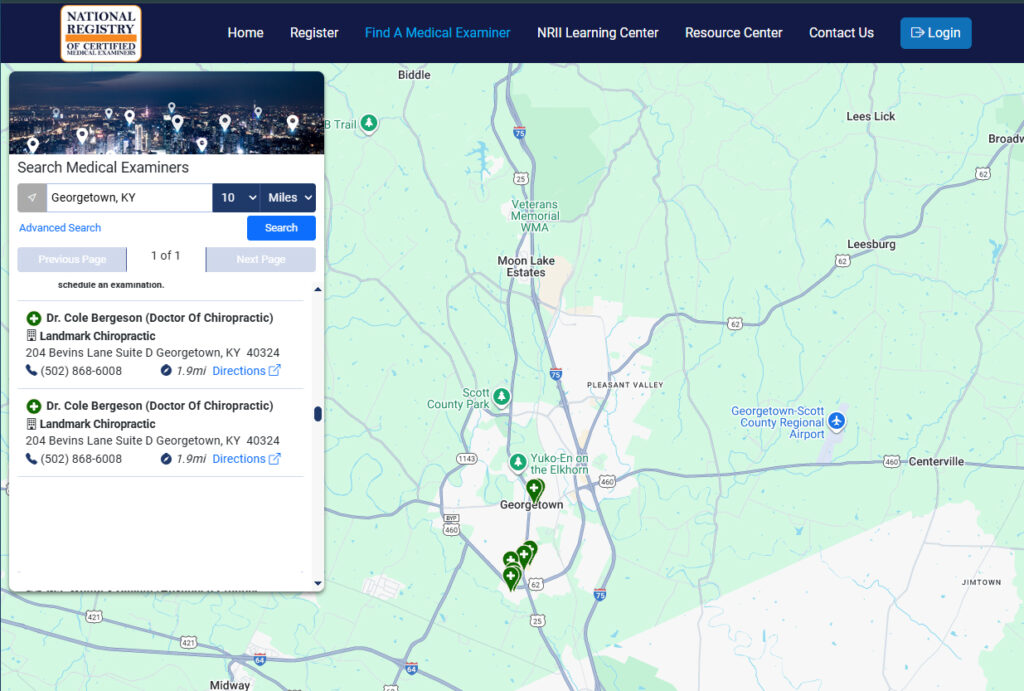
These certified professionals undergo specialized training to ensure they understand DOT safety standards and federal medical regulations.
How Much Does a DOT Physical Cost?
The cost of a DOT physical generally ranges from $75 to $150, depending on the clinic, state, and any additional testing required. Some employers cover the cost for their drivers, while others require the driver to pay out of pocket. Regardless, the investment is minor compared to the importance of maintaining a valid medical certificate and avoiding potential fines or disqualification.
Just because you are required to have a service performed, you shouldn’t be required to pay outrageous prices. Since we are a small clinic we are able to keep our overhead low and pass the savings on to you. At Landmark Chiropractic, Dr. Bergeson charges $75 per physical, you won’t find a better value anywhere.

How Do You Submit Your DOT Physical Information?
Drivers do not submit records directly to the Department of Transportation. Instead:
- The Certified Medical Examiner completes the Medical Examination Report (MER) and issues a Medical Examiner’s Certificate (MEC) if the driver is approved.
- The driver must carry their valid MEC card while operating a commercial vehicle.
- Drivers must also provide the MEC to their State Driver Licensing Agency (SDLA), where it is added to their driving record.
- Some states allow online submission, while others require in-person or mailed documentation—drivers should check their state’s specific requirements.
The medical examiner is responsible for uploading exam results directly into the FMCSA National Registry, ensuring the DOT has secure and accurate records.
Why Choose Landmark Chiropractic for your DOT Physical?
Don’t sit in a waiting room for hours with a bunch of sick people. Most of our drivers are in and out of the office in around 30 minutes. Dr. Bergeson can examine drivers from any state. Additionally, drivers need not supply any forms – Dr. Bergeson has medical cards and other materials required. Our office and staff is experienced and equipped to provide fast, efficient, comprehensive D.O.T. examinations. Dr. Bergeson will perform physicals onsite if 5 or more drivers need an exam at a time.
Feel free to use our online scheduling tool to set up your appointment 24-7!